In Strasbourg

In Strasbourg

Saturday, December 4, 2010

Our Dutch Christmas - with Sinterklaas and Swarte Piet

Last night about thirty of us - Aarnoutse, Schippers, Maas and O'Briens and our extended families - gathered at Renee and Api's to celebrate Sinterklaas. We came from Dordrecht, Hook, Rotterdam, Sydney and Canberra. It was a corker of a night.

Sinterklaas is the dutch father christmas. He is an omniscient, bishop-like figure with a shepherd's staff. Like the pope, but younger and he does house calls.

He arrives in late November by steamship from Spain. He is accompanied by Swarte Piet, his black helper. Swarte Piet has a face painted black and is dressed in renaissance silk pantaloons and vest. I was reminded of an Indian jockey. 

Both characters are relatively recent in dutch mythology, shaped mostly by authors and illustrators since the 1850s (that is, a hundred years or so after our house here was built!). They are not without controversy, which I will, uncharacteristically, shy away from here. You can find out more.

Sinterklaas has kept a book on you - he knows everything. If you have been good, you are showered with lollies and gifts. If you have been bad, you are bundled into Swarte Piet's sack and spirited away to Spain. And we have booked Sinterklaas and Swarte Piet for six thirty! The tension is palpable.

But first, we feast! Everyone has cooked up a storm. There are tord man pla, samosa, satay, nasi and bami, a spicy, Turkish pastry and more. Syl and I have bought up big at the kaasboer. 

The snow outside the back door is the dutch beer fridge. There is a huge stash of wine and beer. Although it looks to me to be enough for a month, the Australian factor has been underestimated. There will later be a mercy dash for another crate of Heineken. 

The kids while away the time decorating huge speculaas Sinterklaas biscuits with icing and lollies, nibbling at their creations as they go. And playing in the snow. For it is snowing heavily - big dry flakes are wafting down to form a deep layer over previous falls. Ideal for the sled that has appeared from Api's shed and the snow fights that reach battle status. 

The aussie kids hook into all this without a blink. To me, they look like characters in a fairy tale. This is the christmas I saw on TV as we flopped listless on the lounge after sweating our way through Mum's roast chook. 

A loud rap on the window announces the arrival of Sinterklaas and Swarte Piets, three of them. Noa, two, wails in fright, but quickly settles as Sinter opens his book. Each child takes a turn at his side as he reviews their behaviour over the year. Sinter has praise for their achievements. They bask. He has dirt they could not imagine. They grimace and blush. Even urbane Caity squirms away. 

Miraculously, the children all pass muster. Presents appear and no-one is whisked away to Spain. The kids go back to snow-fights and sled rides. Sinter marches off into the snow and his next gig. 

Adults return to their nosh and drinks, occasionally braving the cold to pull kids around on the sled, or pelt them with snow. It is so cold and the snow so light, that snow balls can only be formed gloves off, with the warmth of your hands. Hugh and Lachlan, especially, are in their icy element, clobbering us mercilessly with snowy mortars.

  Heerlijk!   


Friday, December 3, 2010

Three seasons in Dordrecht

The day we arrived in Dordrecht, we walked down to Jongepier and enjoyed drinks looking out over the busy river junction. It was a summery day - shirts, sunshine and promenading. Each day the Scheffersplein would fill with people having lunch or a sociable coffee or drink.

When we came back to Dordrecht in November, most of the leaves had turned or fallen. There was a chill in the air and for the first time we rustled through our cases for gloves and scarves. The air was crisp, the light bright and the days shortening.

This week, the town is a snow covered delight. The boats are dusted in snow, the playing fields are white and the light is watery, thin. In the mornings, it is superbly white, quiet, insulated, hushed. The smaller canals have already frozen and the ice skating will soon begin.

It is bitterly cold - minus something all of the time and bitingly cold when the wind blows. Even Hugh, who I was convinced was born without the ability to detect cold, who would cheerfully volunteer to test whether the canal ice will hold his weight, has today complained of cold feet. We have added all our layers, gloves, scarves, hats. And still the cold can make you wince or squeal.

The solution? Short, brisk forays outside, with longer lunches looking out at the postcard views!


Thursday, December 2, 2010

Ypres Salient


Ypres is a Belgian city of about 30,000 people. It has a glorious past, once the centre of Europe's textile industry and a very wealthy place. 

It was completely destroyed in the first world war - only smoking ruins remained. The rebuilding of Ypres is remarkable. Its major cathedrals, great square and civic buildings have been reconstructed to original designs. It has the feel of a much larger centre. The war is an important business for Ypres - with 500,000 allies killed in this area alone, lots of people are connected and visit. 

With Christmas approaching, the square was decked out with an ice rink and market. I bought a hat, despite having the sort of head that should be uncovered - or fully covered. 

Around Ypres - 'wipers' to the allies - the countryside is gently rolling farmland, picturesque under the snow. War cemeteries are everywhere. Ploughed fields remain full of the detritus of war - a memorabilia shopkeeper told me that if you haven't picked up a bullet or buckle after five minutes walk, you aren't looking.  

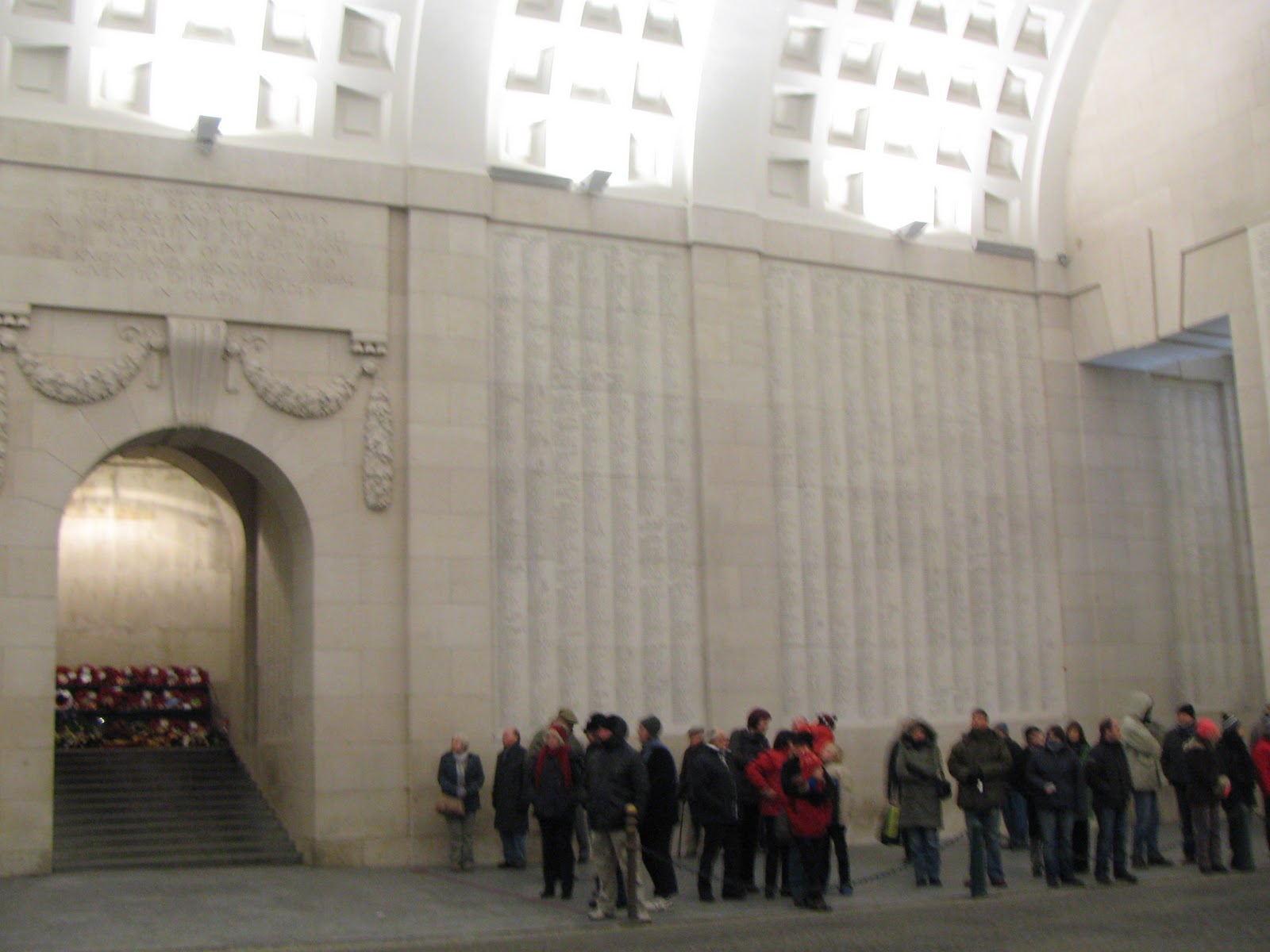
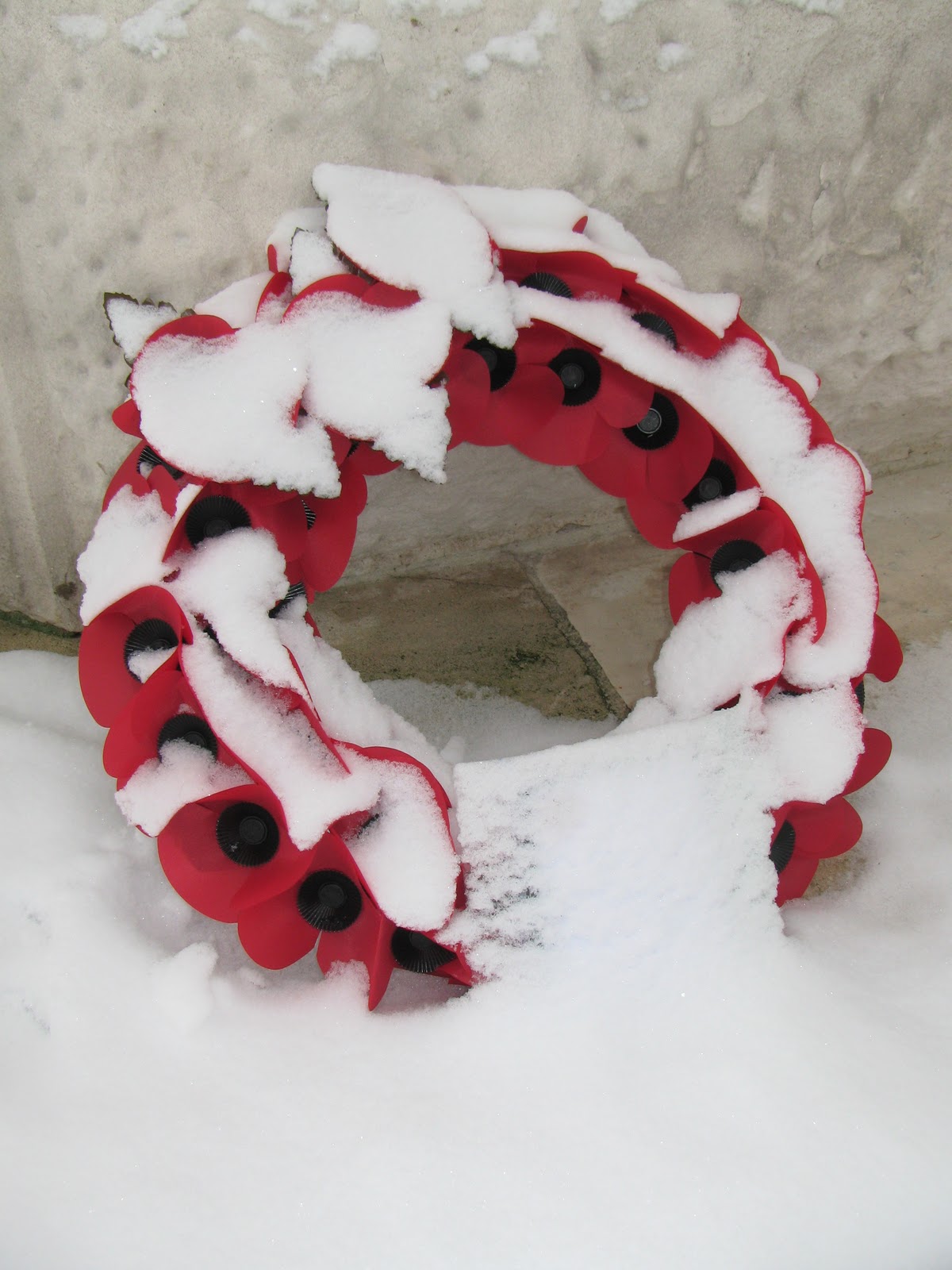
One icy night we walked down to Menin Gate for the service that happens there every night at eight - and has since 1928. About a hundred shivering souls joined us for a short, moving last post. Oh so many young men perished here. It is palpable, a hundred years on.


Real snow


Fake snow

Menin Gate in the distance


Christmas market in the great square

A pensive Hugh at Menin Gate

Eight pm at Menin Gate

Pheasant tracks


the rebuilt Ypres cloth market


Wednesday, December 1, 2010

Estaires - resting place of James Hambleton

My great grandfather James Hambleton died in the first World War. He is buried in Estaires on the French battlefields. We went to pay our respects.

James was a miner, born in Bendigo. He didn't have an easy life. His mother died when he was very young. He was orphaned at nine, when his father, also a miner, was killed in a mining accident. The four children were raised by mining families.

James met and married Matilda Allsopp at Lucknow, near Orange. They had one daughter, Gladys, our Nan. The family moved to Broken Hill, where James was a miner. Gladys would play the organ at St James, would meet George Herbert, marry, have babies Joan, Dorothy and Alan. She was a delight as a Nan, but grew sad and quiet when asked about her dad.

Meanwhile, Germany had invaded Belgium and France and the mighty Commonwealth was responding with force, calling on Australia and New Zealand, among others.

By 1916, the conflict had bogged down in deadly trench warfare along a wide front. England hatched a plan to tunnel under the enemy line and explode massive bombs. Miners were recruited in their thousands from England and the colonies for the job.

James joined them at the age of 41, probably old for a miner, leaving Nan a girl of sixteen. He sailed to England and then the front. He was dead within six months of bronchitis. The tunnelling companies completed their deadly work. The bombs were exploded - the biggest explosion the world had known then - heard and felt in London. The enemy was in disarray and Messines Ridge rapidly taken by the allies.

We caught the train down to Brussels and changed for Ypres. Here stands the Menin Gate and most allied troops passed this place as they marched to the front. Ypres was reduced to rubble in the war but has been rebuilt. It is a beautiful city, with an exquisite baroque 'cloth hall' and churches. We walked to our hotel from the station. It was bitterly cold.

It snowed overnight and the kids delighted in dusting the car and playing around before we drove to Estaires. Half an hour in the car with Dad driving on the wrong side of a snowy road and Mum navigating with inadequate maps produced the appropriate level of solemnity in them as we approached the cemetery.

The Estaires communal cemetery holds both military and civilian graves. Gravely ill, James was taken from the trenches to a field hospital in a school there, where he died. We found his grave among many. There was snow on the ground and an icy wind.

I imagined being a soldier there, cold, afraid and sick, in the mud and ice. And I imagined my grandmother and her mother, hearing after Christmas that he had died on 18 December 1916. So sad.

Sometime later, they would receive a medal with his name - so many were sent that they came to be known as a 'dead man's penny'. Unlike us, they would never visit his grave on the other side of the world. So sad.

It begins to snow. We take photos. The kids dust snow from headstones. Hugh starts playing around on the slippery stones and I chip him angrily, mutter something about respect, regret it instantly.

We leave a photo - perhaps the last taken of James, at his grave. He is in uniform, standing with his daughter and wife. He is not a young man and looking at it, I wonder why he went. Was it patriotism? The special need for miners?

We drive on to Messines Ridge, where the tunnellers did their work. In my mind, the ridge was sharp and dangerous. In front of me is a gentle rise in farm land, snow covered, peaceful. Where one of the mines was exploded, taking with it Germans and their munitions, there is now a huge crater. It has filled with icy water, is surrounded by forest, has been renamed the peace pool. So sad.

Later, we drive to Tyne Cot cemetery. I think we do this because it is the largest of all the countless military cemeteries. God knows why biggest is best when it comes to cemeteries. It is snowing and bitterly cold. I learn that the central monument is built around a concrete German bunker, taken by Australians. Oi oi oi.

We go back to our hotel, which is lovely and warm.